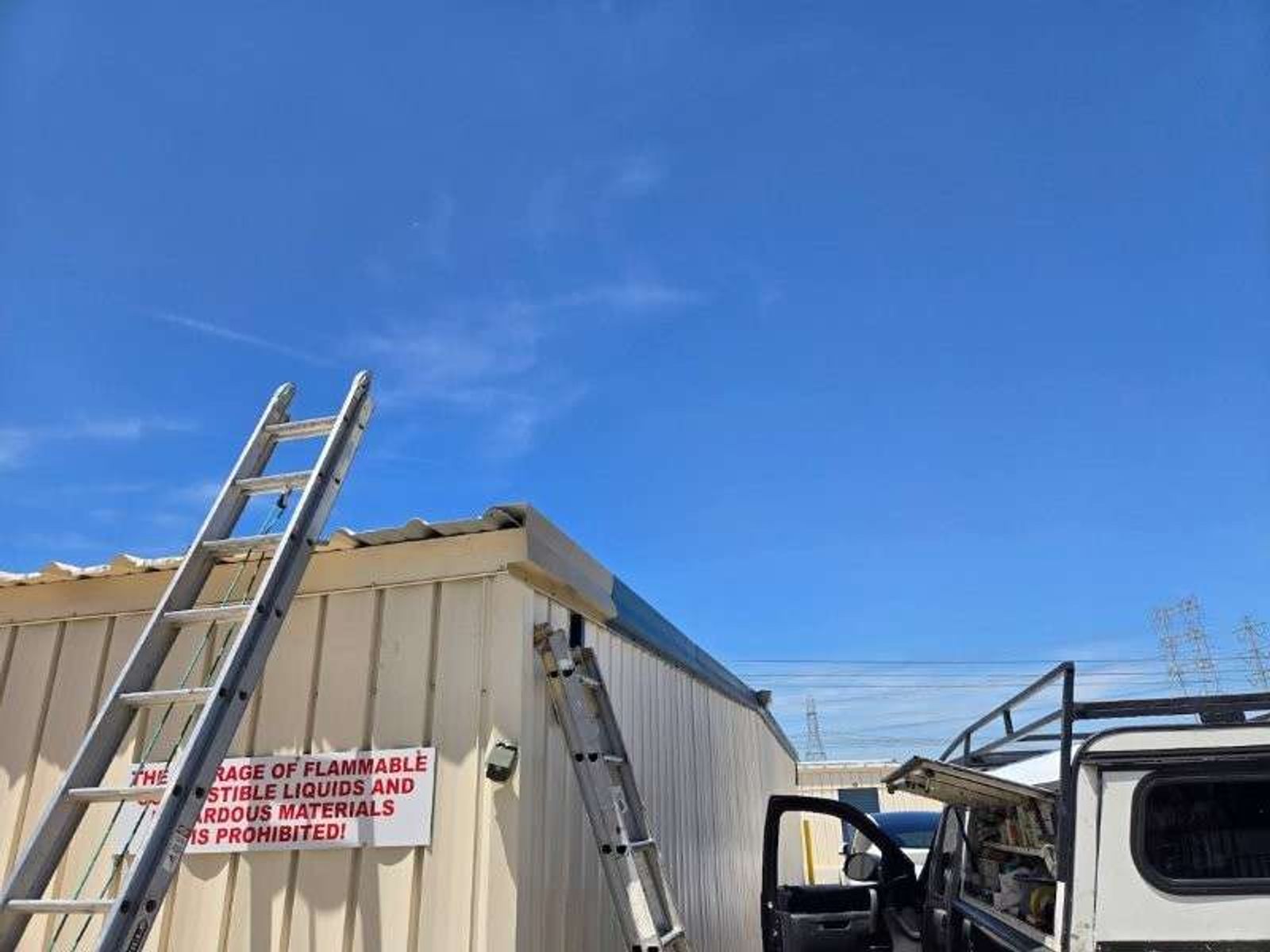
Metal roof restoration brings an aging commercial metal roof back to a sealed, protected condition without replacing the panels. The work treats rust, fixes the fasteners and seams, and puts a continuous coating over the whole roof. It suits warehouses, industrial buildings, and older shop buildings across greater Los Angeles.
Metal panels themselves can last a long time. What gives out first is everything that holds them together and keeps water out. That is the part a restoration rebuilds.
How metal roofs age
Metal moves every day. Panels grow in the afternoon heat and shrink overnight, and that cycle works fasteners loose over years of Los Angeles sun. Each loose screw enlarges its hole a little more with every cycle.
The rubber washers under the screw heads dry out and crack. Sealant at end laps and side laps hardens and pulls away. The factory finish chalks and wears thin, which leaves the steel exposed at cut edges and scratches.
Rust usually starts in predictable places. Lap joints hold moisture, low panel ends near gutters stay damp, and anywhere dissimilar metals touch can corrode faster. These are the spots we check first on a walk.
What we check before writing a scope
A metal roof is only worth restoring if the panels and structure can carry another cycle. The walk answers that question before any coating is discussed. These are the conditions we record.
- Rust type: light surface rust, heavier scale, or holes rusted through the panel.
- Fastener condition, including backed-out, stripped, missing, and over-driven screws.
- Side laps and end laps, where old sealant has split or the panels have separated.
- Flashings at ridges, walls, curbs, and gutters, plus any trim that has lifted.
- Skylight panels, which are often brittle and cracked by the time the roof is restored.
- The structure below, where we can see it, for rust at purlins and clips.
Holes and badly corroded panels do not get coated. They get cut out and replaced with new panels, which then become part of the restored field. The general rules on which roofs can take a coating apply to metal as well.
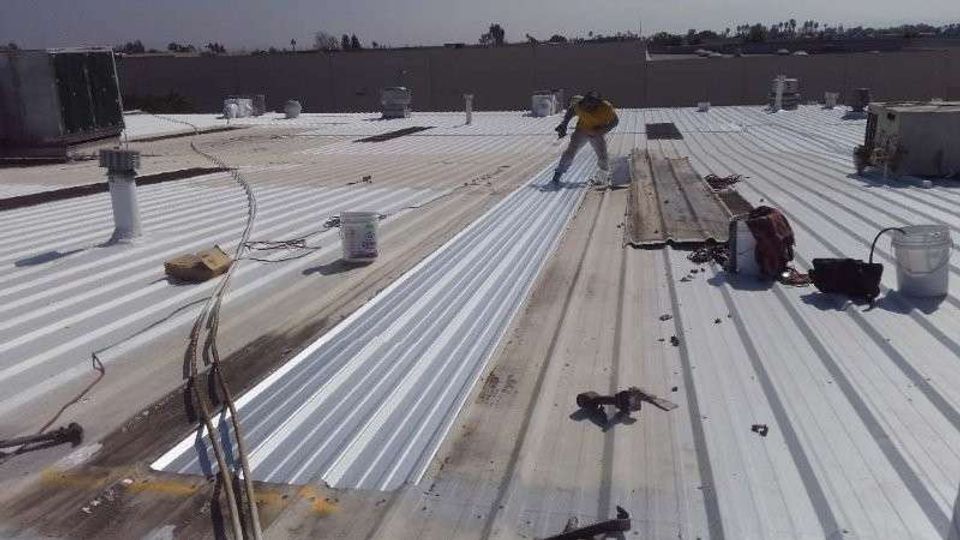
New white corrugated panels going in next to weathered tan panels on a commercial roof.
Rust and fastener repair
Rust treatment starts with removing what is loose. Scale and flaking rust are taken off by wire brush or grinder, and the surface is cleaned of oil and chalk. A rust-inhibiting primer then goes on the treated areas before anything else.
Fasteners are handled one by one. Loose screws are tightened, and stripped ones are replaced with a slightly larger size to grab fresh metal. Every exposed head is then sealed so the coating has a continuous surface to cover.
Seam sealing and flashings
Laps are where most metal roof leaks start. Wind-driven rain pushes water uphill under a lap, and capillary action draws it farther in. Seam sealing closes that path at every side lap and end lap on the roof.
The seams get cleaned, then covered with sealant and reinforcing fabric or seam tape so they can flex without cracking. Flashings at walls, curbs, and ridges get the same treatment.
Where a flashing is bent, loose, or rusted through, it is replaced before it is sealed. The approach matches our flashing repair work at walls and curbs on other roof types.
Recoating a metal roof
The coating goes on last, over clean, primed, and sealed panels. It covers the field, the fastener heads, and the sealed laps in one continuous film. That film is what keeps the steel dry and slows the next round of rust.
Acrylic and silicone are both common choices on metal, and each has tradeoffs on slope, ponding, and future recoats. The acrylic coating option for sloped metal panels is often the fit where water runs off freely. Low areas that hold water may call for something else, and the proposal names the system and thickness.
Some metal roofs are low-slope. On a nonresidential building, a recoat of a low-slope roof can fall under the cool roof rules in the 2025 California Energy Code. We check the slope and the area involved when we write the scope.
Restore or replace the metal
Sound panels with surface rust and leaking fasteners are a restoration job. Panels rusted through across large areas, or a structure that has lost its hold, are a replacement job. Most roofs land clearly on one side once the walk is done.
For long-term planning, HUD's useful life table uses 50 years for sloped metal roofs. That is a planning average, and the fasteners and sealants on the same roof wear out much sooner. That gap is why restoring the details makes sense on panels with decades left in them.
When the panels are finished, the scope moves to new commercial metal roof panels. Either way, the decision should rest on what the walk found, which our roof restoration overview explains in more depth.
What drives metal roof restoration cost
The size of the roof matters, but condition matters more. A roof with tight fasteners and light chalking costs far less to restore than one with rust at every lap. The proposal lists each part of the work so the price makes sense.
The largest drivers are the number of fasteners to replace, how much rust treatment the panels need, and how many panels must be swapped out. Skylight replacements, gutter work, and access around rooftop equipment add to it. The written proposal carries the number.
Working safely on metal roofs
Metal roofs bring their own hazards. Skylight panels look solid but will not hold a person, and wet or chalky metal is slick underfoot. Federal rules set a duty to protect workers from falls through skylights and roof openings, and we plan the work around that.
Occupied buildings add another layer. Grinding and rust removal create dust and noise, and primers and coatings have odors near air intakes. The schedule works around tenant hours, and rooftop units can be shut down or their intakes covered while that section is coated.
You get a closeout record at the end. It shows the panels replaced, the fasteners and seams treated, and the coating applied, with dated photos for the property file.
Questions on this service
Can you coat over a rusty metal roof?
Yes, once the rust is treated. Loose scale is removed, the steel is cleaned, and a rust-inhibiting primer goes on before any coating. Coating straight over active rust traps it, and it keeps spreading under the film.
How do you stop leaks at metal roof screws?
Each exposed fastener gets checked. Loose or stripped screws are replaced, often with a slightly larger size so they bite into fresh metal. The heads and washers are then sealed and covered as part of the coating system.
Can a standing seam metal roof be restored?
Often, yes. Standing seam roofs have far fewer exposed fasteners, so the work centers on seams, end laps, clips, and flashings at walls and curbs. A coating can go over the full panel field once those details are sealed and the surface is prepared.
What happens to the skylight panels on a metal roof during restoration?
Fiberglass or plastic skylight panels are inspected on their own. Brittle or cracked panels are usually replaced, since coating them blocks the light and does not restore their strength. Crews also treat every skylight as a fall hazard while they work around it.
Does a coating help with metal roof expansion and contraction?
An elastomeric coating stretches and recovers as the panels move with daily temperature swings. That flexibility keeps the seal intact at laps and fasteners where the movement is greatest. A light, reflective finish also lowers the surface temperature, which reduces how far the panels move each day.
Related commercial roof restoration services
This page is one part of commercial roof restoration. The pages below cover the rest.
Other commercial roof services
Each property usually needs one clear scope, not all five at once. The walk tells us which page below matches the building.
- Commercial Roof Repair
- Commercial Roof Coatings
- Commercial Roof System Installations
- Commercial Roof Inspection and Certification
Ready for a written scope? Request a site visit or call (747) 308-4045.