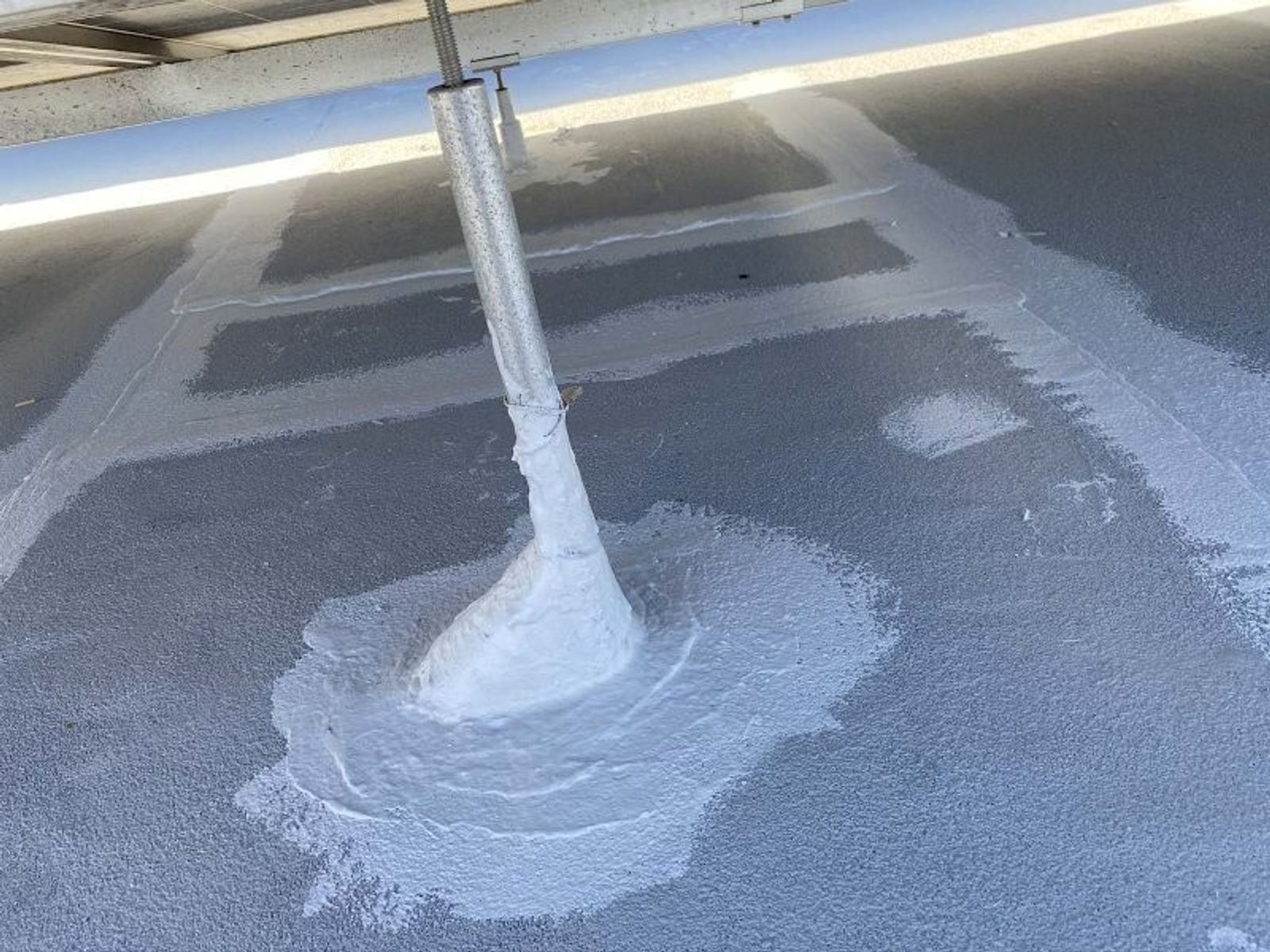
Roof flashing repair fixes the places where a flat roof stops being flat. Walls, curbs, pipes, drains, and edges all interrupt the membrane. Each of those joints needs its own seal, and each one ages faster than the open roof.
We repair flashing on commercial and industrial roofs across greater Los Angeles. That covers parapet flashing, curb flashing at rooftop units, pipe boot repair, and edge metal. Flashing is the most common source we find when tracing commercial roof leaks back to their cause.
What flashing is and why it fails
Flashing carries the waterproofing up and over anything that interrupts the roof. At a wall, the membrane turns up the face and ends at a sealed top edge. A metal counterflashing or cap then covers that edge so water runs past it.
Flashings fail for predictable reasons. The roof and the wall move differently as temperatures swing, which stresses the corner between them. Sealant at the top edge dries and cracks in the sun, and fasteners loosen as the building flexes.
Height matters too. Flashing has to rise high enough above the roof that ponded or wind-driven water cannot top it. Roofs that were built up over the years often leave old flashings too short.
Parapet and wall flashing
Parapets are the low walls around the edge of many Los Angeles commercial roofs. They catch water on three sides: the roof face, the top, and the outside wall. A leak at any of those can show up inside.
On the roof side, the base flashing can pull loose from the wall or split along the corner. On top, joints in the metal coping open and let water into the wall. Stucco parapets add another path, because water can enter cracks in the stucco and run down behind the flashing.
Repairs start by finding which path the water is taking. We re-secure or replace the base flashing, reset the termination, and seal or replace coping joints. Stucco cracks get noted for the building owner, since they are wall work and not roofing.
Curb flashing at HVAC units and skylights
Rooftop units sit on raised curbs, and each curb is a four-sided flashing detail. The corners are where they fail most. Service crews walking and kneeling around the unit add wear.
Unit swaps cause many curb leaks. A new unit often needs an adapter curb, and the old flashing rarely matches its height or shape. If the roofer is not part of the swap, the curb may be left with sealant and hope.
Skylight curbs work the same way. The flashing wraps the curb, and the skylight frame covers its top edge. Cracked frames or failed gaskets above the flashing can mimic a flashing leak, so both get checked.
Abandoned curbs and dead penetrations
Older buildings collect curbs and pipes that no longer serve anything. A unit gets removed, and the curb stays behind with a plywood cover. Old vent stacks get cut short and capped.
Each of those is still a flashing detail, and nobody maintains it. We note them on every visit. Where it makes sense, the proposal lists removing the curb or pipe and patching the roof flat, which takes one more leak point off the roof for good.
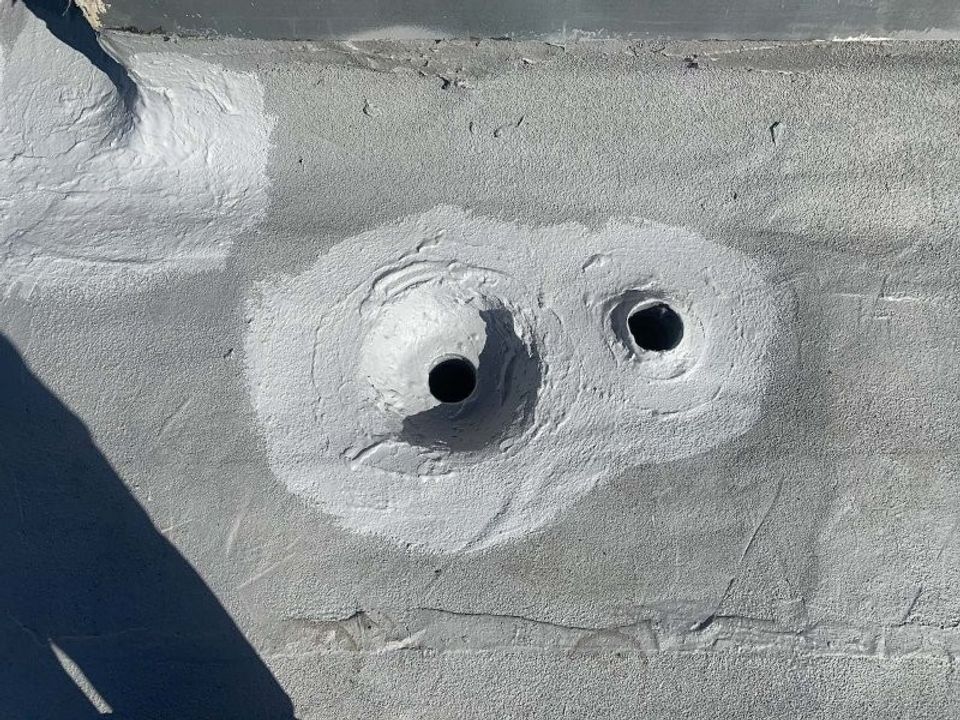
Coating work around a roof penetration on a flat commercial membrane.
Pipe boots, pitch pans, and other penetrations
Every pipe, vent, conduit, and support that passes through the roof needs a seal. The type depends on the shape and on the membrane. Most of them fall into a few groups.
- Pipe boots, which slip over round pipes and clamp at the top. The rubber or membrane collar cracks with age.
- Pitch pans, metal collars filled with sealant around odd shapes. The filler shrinks and pulls away.
- Conduit clusters, where several lines pass close together and are hard to seal one by one.
- Solar racking feet and equipment supports, each one a small penetration of its own.
- Drains and scuppers, where the membrane is clamped or wrapped into metal.
On single-ply roofs, prefabricated boots and field-wrapped flashings can be welded to the sheet. Our page on welding repairs on TPO membrane covers that process. On built-up and coated roofs, penetrations are stripped in with compatible plies or reinforced coating.
Roof edges and scuppers
The roof edge is flashing too. Gravel stops, drip edges, and coping hold the membrane down at the perimeter, where wind pulls hardest. Once an edge loosens, wind can work under the membrane behind it.
Edge metal design has its own industry standard. The ANSI/SPRI/FM 4435/ES-1 standard covers wind design for low-slope roof edge systems. After a big wind event, edges are the first place to check, as covered on our post-storm roof assessment page.
Scuppers are openings through the parapet that drain water off the roof. The membrane wraps into the opening and seals to a metal liner. Cracks at the corners of that liner are a common leak.
What drives flashing repair cost
Flashing work is detail work, so cost follows the number and complexity of details. The written proposal carries the number and lists each item. A few factors move it most.
Resealing one pipe boot is small. Rebuilding the flashing around a large rooftop unit or a long run of parapet takes more material and more hours. Custom metal, such as new coping or an edge fabricated to fit, adds shop time.
Access and coordination also count. Units may need to be lifted, or solar may need to be disconnected by its own installer first. Wet insulation found under a failed flashing adds to the scope.
Keeping flashings sound
Flashings deserve a close look on every roof walk. Roofing trade guidance calls for inspecting low-slope roofs twice a year and after severe weather. Our notes on how often to inspect a commercial roof cover the schedule.
Small flashing repairs caught early keep water out of the insulation. They are among the most cost-effective jobs in our commercial roof repair work. Every one gets photographed so you can track it over time.
Questions on this service
What is roof flashing on a commercial building?
Flashing is the material that seals the roof where it meets something else. That includes walls, parapets, curbs, pipes, drains, and the roof edge. It is usually a strip of membrane turned up the vertical surface, often covered by a metal cap or counterflashing.
How do I know if my roof flashing is failing?
Leaks near walls, units, or pipes are the most common sign. On the roof, look for membrane pulling away from a wall, cracked sealant at the top edge, loose metal caps, or split rubber around pipes. Stains on the inside of a parapet wall also point to flashing trouble.
What is a pitch pan and why does it leak?
A pitch pan is a metal collar around a penetration that is filled with sealant. As the filler shrinks and cracks with age, a gap opens around the pipe or support and water runs down it. Pans need topping off over time, and many are replaced with a membrane boot during repairs.
Should flashing be replaced when a new HVAC unit goes in?
Usually, yes. Swapping a unit often means a new or adapted curb, and the old flashing rarely fits it cleanly. Having the roofer flash the curb as part of the unit change avoids a leak that shows up with the next rain.
Can flashing be repaired without replacing the whole roof?
Yes. Flashing is often the first part of a roof to fail, and it can be repaired or replaced on its own. The new flashing must be compatible with the existing membrane so it can be welded or bonded to it.
Related commercial roof repair services
This page is one part of commercial roof repair. The pages below cover the rest.
- Commercial Roof Leak Repair
- Flat Roof Repair
- Emergency Roof Repair
- Storm Damage Roof Repair
- TPO Roof Repair
Other commercial roof services
Each property usually needs one clear scope, not all five at once. The walk tells us which page below matches the building.
- Commercial Roof Coatings
- Commercial Roof Restoration
- Commercial Roof System Installations
- Commercial Roof Inspection and Certification
Ready for a written scope? Request a site visit or call (747) 308-4045.