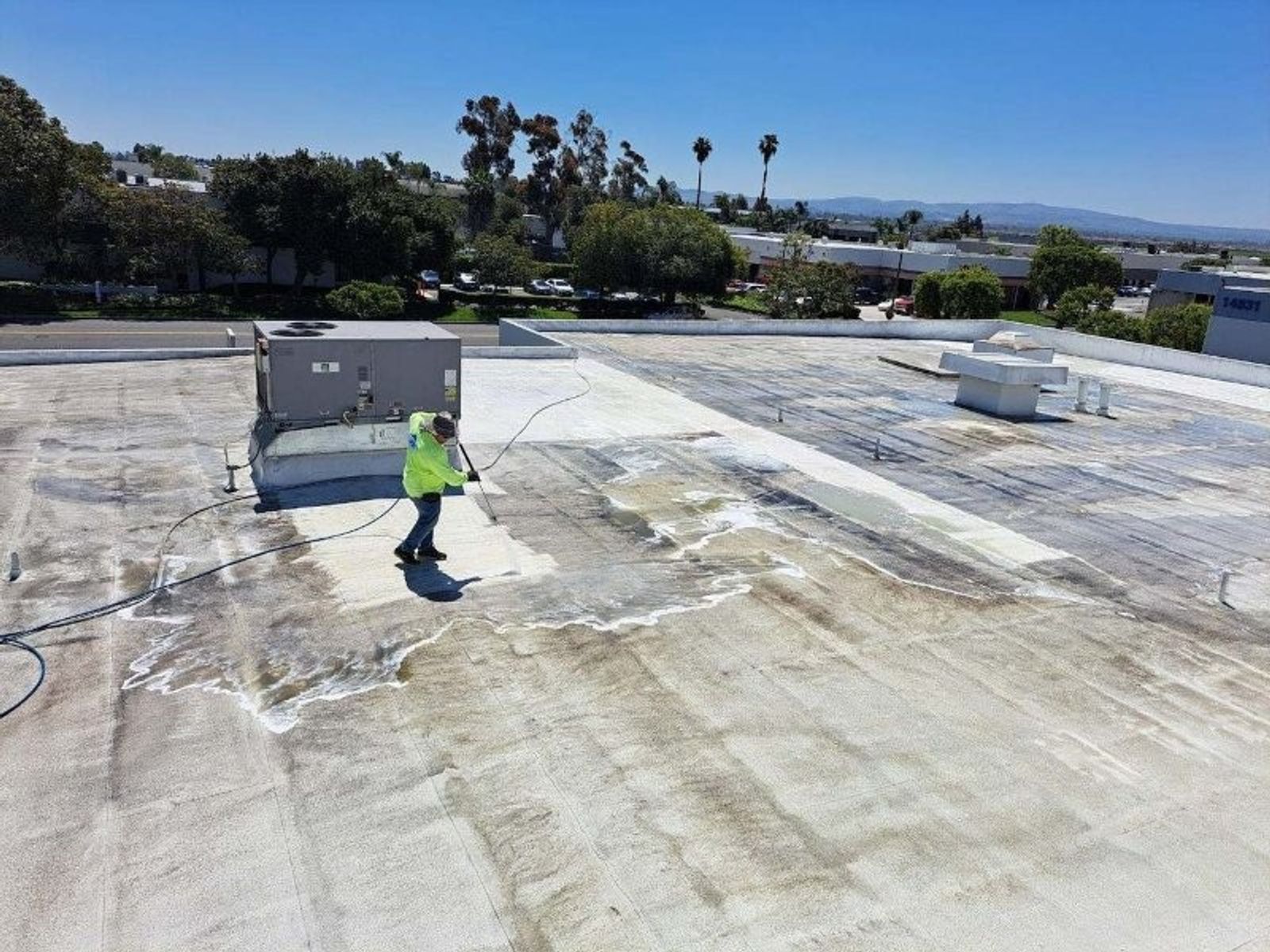
Commercial roof repair is what stops the water and keeps a building out of a replacement conversation it does not need yet. We work on low-slope and flat commercial roofs across greater Los Angeles, for property managers, facilities directors, and building owners. We do not take residential or shingle work.
A repair starts with finding the source, not the drip. Water travels along the deck, runs down a seam, and shows up through the ceiling somewhere else entirely. The walk traces it back before anyone opens the membrane.
Leak triage for property managers
The first hour of a leak belongs to you, not to the roofer. What happens before a crew arrives decides how much of the interior loss you avoid. None of it takes roofing skill.
- Protect the interior. Move stock, electronics, and paper out of the water path, then tarp and bucket whatever has to stay.
- Document it. Photograph the ceiling, the floor, and the equipment with a timestamp, because dated photos matter later.
- Clear what is safe to clear. If roof access is safe, pull debris off the nearest drain or scupper.
- Call it in with detail. The address, the roof type if you know it, the interior location, and whether the building is occupied.
Roof leak repair moves faster when the interior evidence is already mapped. A stain under a skylight and a stain in the middle of an open bay are two different searches. Tell us which one you have.
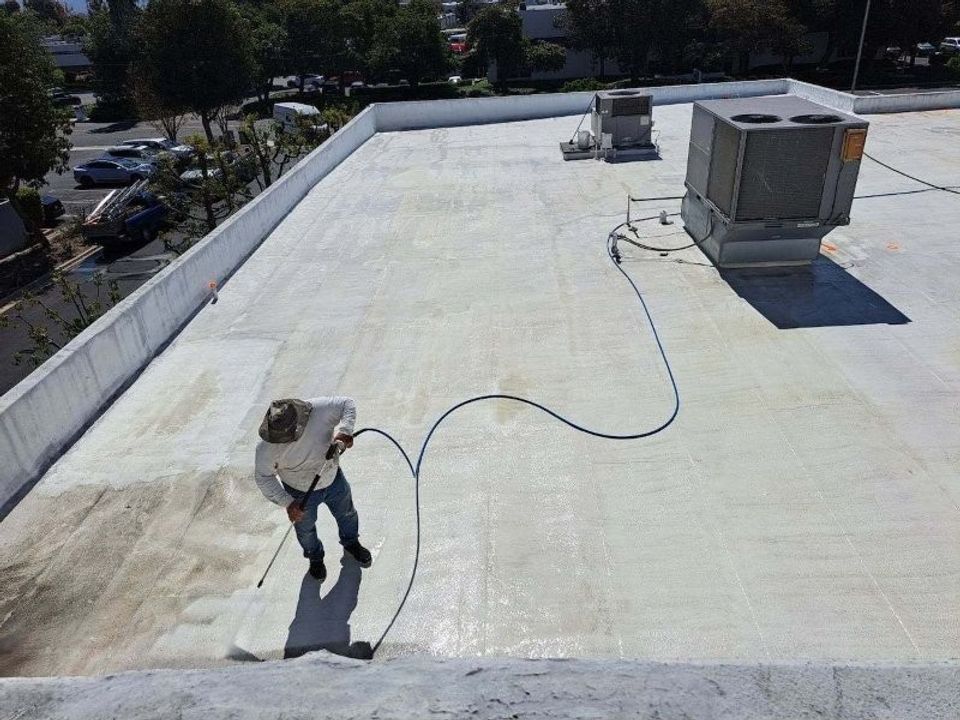
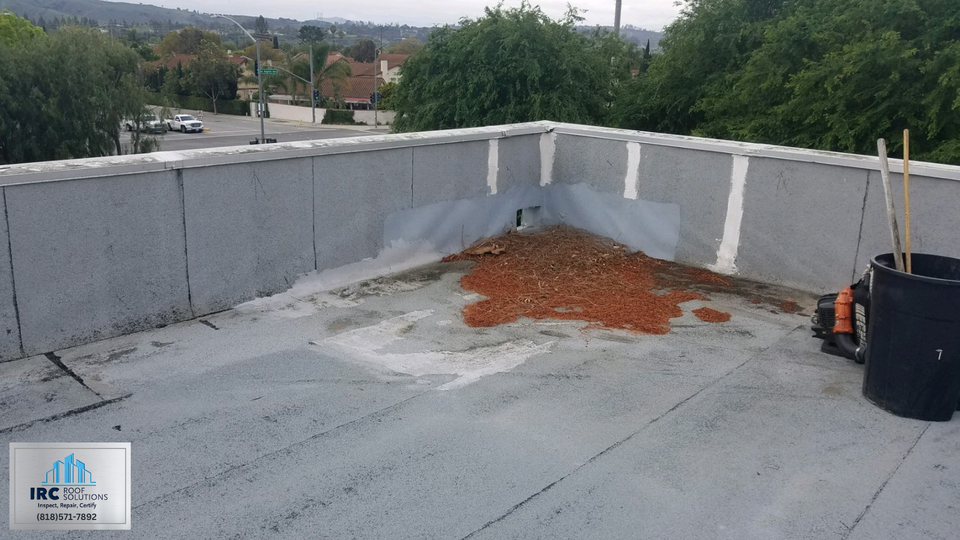
Cleaned commercial roof field, ready for repair work.
How we find the source
We start at the interior location and work uphill on the roof. Seams, laps, penetrations, curbs, and drains all get checked before anything gets cut open. Where the surface hides the path, we look for wet insulation instead of guessing.
Flat roof repair on TPO, PVC, built-up and coated membranes
Flat roof repair is membrane specific, because the sheets are not interchangeable. A patch that welds to TPO does nothing on modified bitumen. The visit names the system before any material gets ordered.
TPO and PVC
TPO roof repair uses a hot-air weld with matching sheet, so the patch fuses into the membrane rather than sitting on top of it. PVC roof repair works the same way with PVC sheet, and it holds up better where kitchen grease or chemical exhaust lands on the roof. Sheets that have weathered thin may need a primer or a wider patch to hold a sound weld.
Built-up, modified bitumen and coated roofs
Built-up and modified bitumen get repaired in plies, so the patch is layered and sealed rather than welded. Coated roofs need the failed coating cut back to a sound edge before the repair is embedded and the area is recoated. Commercial roof leak repair on a coated roof usually means fixing the detail underneath, not adding more coating on top.
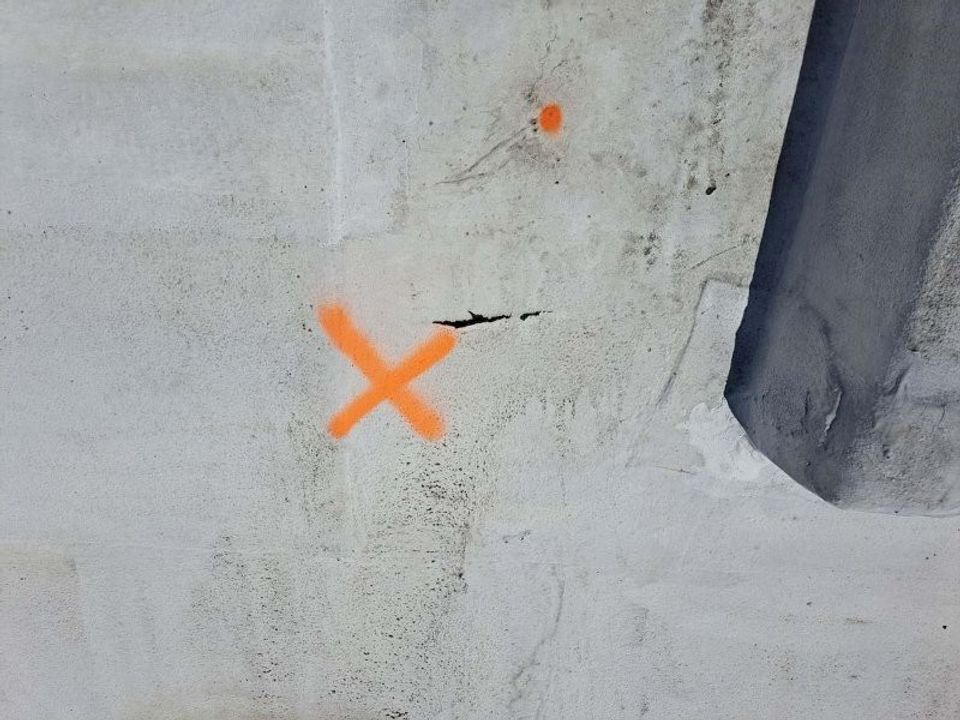
Marked defect on a weathered roof surface, photographed before repair.
Flashing, seams, penetrations and drains
Most leaks are not in the open field, they are at the edges and the holes. Roof flashing repair at walls, curbs, and parapets is the single most common scope we write. Anything that goes through the roof is a candidate.
- Wall and parapet flashings where the termination has pulled loose.
- Curb flashings at HVAC units, especially where a unit was swapped and the curb was never resealed.
- Pipe boots and conduit penetrations with cracked collars.
- Seams and laps that have opened from building movement or age.
- Drains with failed clamping rings, and scuppers packed with debris.
Drains deserve their own line. A blocked drain turns an ordinary storm into a load problem and holds standing water over every weak detail on the roof. Roof damage repair often starts by restoring drainage before anything else gets touched.
Emergency and storm damage repair
Emergency roof repair is containment first and a permanent fix second. During a storm we set temporary seals, tarps, and dams to stop the interior loss, then come back for the real repair once the surface is dry enough to bond. Anything installed onto a wet surface will fail, and we say so up front rather than after.
A storm damaged roof gets photographed before anything is disturbed. We look for wind uplift at the perimeter, punctures from flying debris, displaced equipment, and torn flashings. For emergency roof repair at two in the morning, the useful call is the one that asks for the address and whether the building is occupied.
Our roof repair services run from a single pipe boot to a building-wide leak survey. Every job still comes down to one address, one membrane, and one written scope. Call {{PHONE}} with the property and what you are seeing.
Repair or replace: how we decide
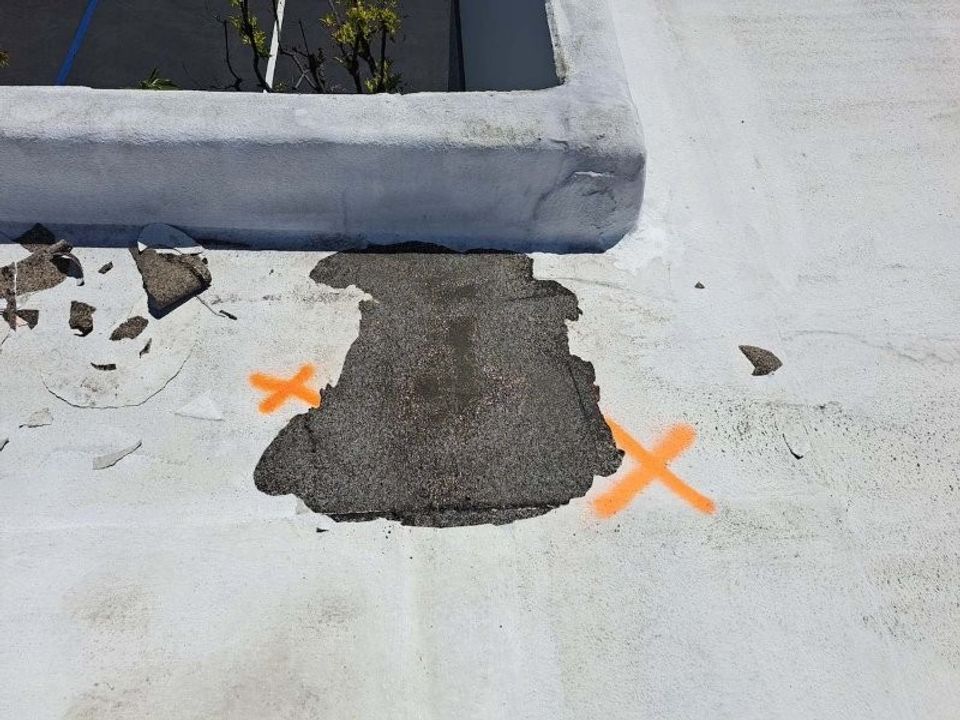
We repair when the membrane is bonded, the insulation is dry, and the failures are countable. We recommend replacement when the survey finds saturated insulation across the field, a soft deck, or the same section failing every season. Between those two sits commercial roof restoration, which keeps the existing system and adds a new surface over it.
The deciding evidence is moisture, not age. A younger roof with wet insulation is a worse candidate for patching than an older roof that is dry throughout. Cores and a moisture survey settle that question in an afternoon.
If the roof is sound and simply losing its surface, a commercial roof coating may be a better spend than another round of patches. If the deck or the insulation is gone, the conversation moves to commercial roof system installation. Either way, a commercial roof inspection is what produces the evidence behind the recommendation.
What drives commercial roof repair cost in Los Angeles
Repair pricing follows access, membrane, and how much of the assembly is wet. Searching commercial roof repair Los Angeles turns up a wide price spread, and the reason is almost always scope rather than margin. Working around rooftop equipment, solar arrays, and occupied business hours costs real time, so we list the drivers in the proposal.
- Membrane type, and whether matching material is still available.
- How much wet insulation has to come out and be replaced.
- Roof access, including hoisting and staging on a tight site.
- Occupied hours, night work, and interior protection.
- Whether drains and flashings need work at the same time.
Current ranges are {{PRICE_RANGE_FROM_IRC}}.
Insurance, leases and who pays
Two questions come up on almost every commercial leak, and both are answered in your paperwork rather than on the roof. We supply the dated photo evidence and a plain condition note. The coverage call belongs to your carrier and the responsibility call belongs to your lease.
Questions on this service
How do you stop a leaking roof during heavy rain?
You cannot dry a roof in a storm, so the first hour is containment. Move stock and electronics out of the water path, tarp and bucket what stays, and photograph the ceiling with a timestamp. If roof access is safe, clear debris off the nearest drain, then call so a crew can set a temporary seal and return for the permanent repair once the surface is dry.
Can TPO roofing be patched?
Yes. TPO is hot-air welded, so a patch of matching sheet fuses to the existing membrane and becomes part of it rather than sitting on top as a bandage. Older TPO that has weathered thin sometimes needs a primer, a wider patch, or a section of new sheet to hold a sound weld.
Is it better to repair or replace a flat roof?
Repair while the membrane is still bonded and the wet insulation is limited to a few countable areas. Replace when the deck is soft, the insulation is saturated across the field, or the same section fails every season. A moisture survey and a core sample settle it faster than anyone's opinion does.
Does commercial insurance cover roof leaks?
It depends on the policy and on what caused the leak. Sudden damage from wind or storm is commonly covered, while wear, ponding, and deferred maintenance usually are not. We give you dated photos and a written condition note for the adjuster, but the coverage decision belongs to your carrier.
Who is responsible for roof repairs in a commercial lease?
It depends on the lease type. A triple net lease often puts roof repair on the tenant and sometimes replacement as well, while a gross lease usually leaves the roof with the landlord. Read the maintenance clause and the capital repair clause before approving a scope, because those two are frequently split between the parties.
How much does flat roof repair cost?
Cost follows the membrane, the access, and how much of the assembly is wet. One pipe boot on a reachable roof is a small job, while a leak over a tenant space that needs night work, interior protection, and insulation replacement is not. Current ranges are {{PRICE_RANGE_FROM_IRC}}.
Other commercial roof services
Each property usually needs one clear scope, not all five at once. The walk tells us which page below matches the building.
- Commercial Roof Coatings
- Commercial Roof Restoration
- Commercial Roof System Installations
- Commercial Roof Inspection and Certification
Ready for a written scope? Request a site visit or call {{PHONE}}.