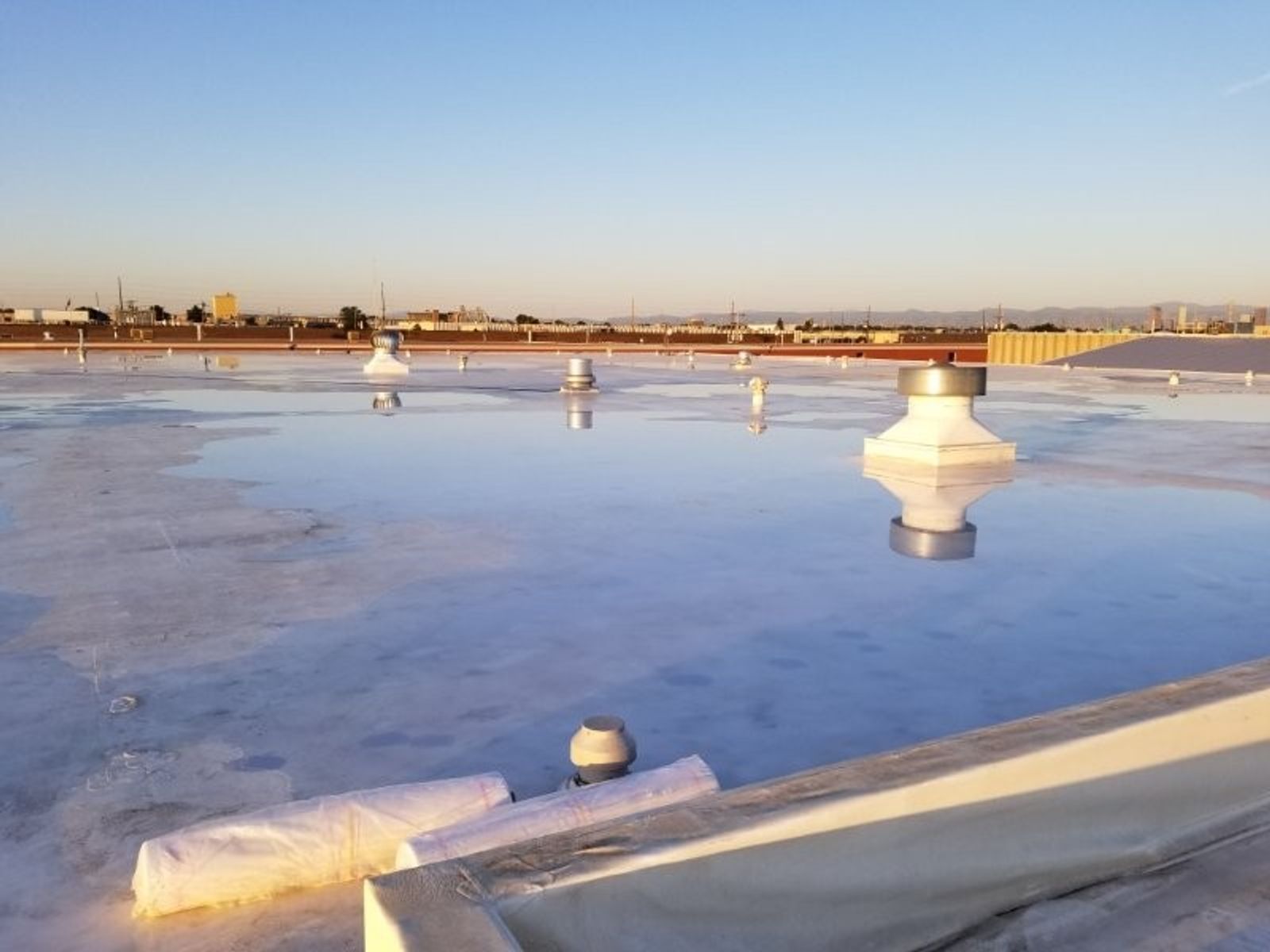
Flat roof repair covers everything that goes wrong with a low-slope membrane after it is installed. Seams open, surfaces crack, blisters form, and water sits where it should drain. Each of those problems has its own fix.
We repair flat roofs on commercial and industrial buildings across greater Los Angeles. Warehouses, strip centers, office buildings, and apartment complexes all fall in that group. If water is already coming through, our page on tracing a roof leak back to its source covers how we find it.
What counts as a flat roof
No commercial roof is truly flat. A low-slope roof has a gentle pitch toward drains, scuppers, or gutters, and the membrane has to shed water across that shallow grade. Any detail that slows the water down becomes a weak point.
Five membrane families cover most of the flat roofs we see in Los Angeles. Single-ply TPO and PVC are heat welded. EPDM rubber is glued or taped. Built-up and modified bitumen are layered in plies, and many older roofs of every type have been coated at some point.
Common flat roof problems we repair
The problems below show up on almost every type of low-slope membrane. How we fix each one depends on what the roof is made of. The visit identifies the system before we write the scope.
- Open seams and laps, where two sheets or plies have separated along the joint.
- Blisters and ridges, where trapped air or moisture lifts the membrane off the layer below.
- Alligatoring and surface cracks on aged built-up roofs and worn coatings.
- Punctures and cuts from foot traffic, dropped tools, and service work on rooftop units.
- Ponding areas that hold water for days after rain.
- Transitions between two roof types, where different materials meet and move differently.
Edges, walls, and penetrations get their own attention because they fail so often. Those details are covered in depth on our parapet, curb, and pipe boot flashing repair page.
How the repair changes by membrane type
Single-ply: TPO, PVC, and EPDM
Thermoplastic sheets can be welded to new material of the same kind. That makes a patch part of the roof instead of a layer glued on top. The specifics of aged sheet, weld testing, and scrim exposure are on our TPO welding and patch repair page.
EPDM cannot be welded. Repairs use cleaned and primed rubber with compatible tape or adhesive. As the rubber ages it can shrink and pull at its edges, so the perimeter gets checked on every EPDM repair.
Built-up and modified bitumen
These roofs are built in layers, so repairs are too. We cut out damaged plies back to sound material, then build the area back up with compatible felts or cap sheet. Loose gravel on a built-up roof gets moved aside and put back after the repair.
Coated roofs
A coating is only as good as its bond to the surface below. Where it has peeled, we remove it to a firm edge, fix the substrate, and reinforce the area before recoating. Coating over a loose or wet surface just hides the problem for a season.
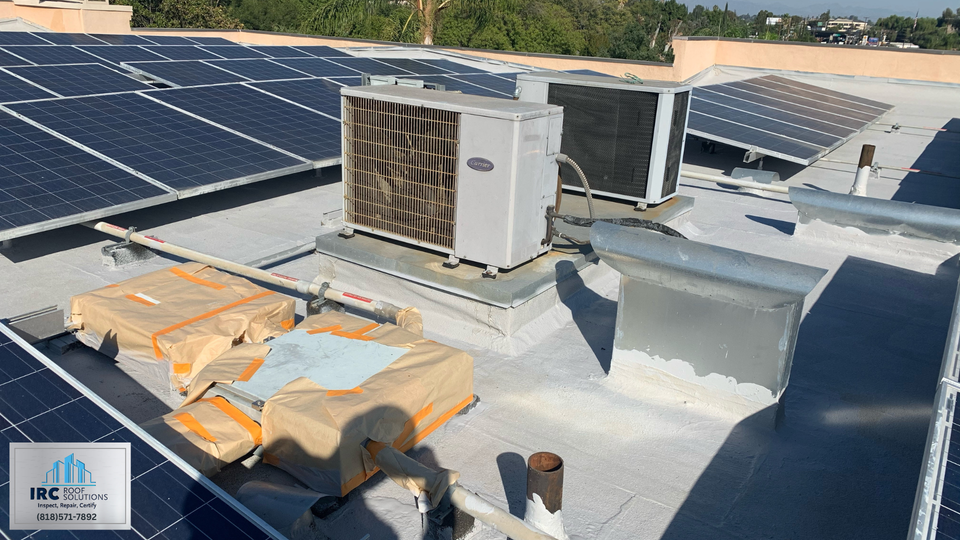
Weathered dark cap sheet on a commercial low-slope roof.
Ponding water and drainage repairs
Standing water is the most visible flat roof problem, and it has several causes. A drain may sit higher than the roof around it. The deck may have sagged between supports, or insulation under the membrane may have crushed from foot traffic.
The fix follows the cause. A clogged or raised drain is a small job. Low areas can often be built up with tapered material or crickets that push water toward the drain, while a sagging structure needs an engineer's eye before anyone adds weight.
Drains themselves last longer than most membranes. HUD's useful life planning table lists low-slope drains and scuppers at 30 years, well past the 15 years it gives single-ply membranes. That gap is why drain bowls and clamping rings often outlast two roofs and need a close look during every repair.
How a flat roof repair visit works
Every visit follows the same order. We look before we cut, and we photograph before we repair. The goal is a scope you can read and approve.
First we walk the whole roof, not just the problem area. We note the membrane type, the condition of seams and flashings, and any ponding. Then we probe the damaged area and check whether the insulation below is dry.
The written proposal lists each repair, the material, and the reason. Dated photos show the condition before and after. That record helps the next person who works on the roof, and it helps you track the same areas over time.
When flat roof repair stops making sense
Repairs work well when the problems are few and the roof around them is sound. They stop making sense when damage is spread across the field. At that point each new patch buys less time than the last one.
The signs are consistent. Brittle membrane that cracks when you fold it, seams failing in several areas at once, and wet insulation in more than a few spots all point to a bigger scope. For roofs that are worn but dry, the choices are laid out in our comparison of restoration versus replacement.
Age alone does not decide it. HUD's table is a planning average for budgets, not a prediction for any single building. A well-kept roof can outlast it and a neglected one can fall short.
Keeping repairs holding over time
Most flat roof damage builds slowly between rains. Clogged drains, loose flashing, and tool punctures from equipment service rarely get noticed until water shows up inside. Regular walks catch them while they are still small.
Industry guidance from the roofing trade press recommends inspecting low-slope roofs twice a year and after severe weather. In Los Angeles, a fall walk before the rainy season matters most. It is also the best time to plan any repair work in dry weather, as part of our wider commercial roof repair work for the building.
Questions on this service
How long does a flat roof repair last?
A repair made with matching material on a clean, dry surface should last as long as the membrane around it. The repair is rarely what fails first. When the surrounding sheet is brittle or wet underneath, the patch is only as durable as the roof it is attached to.
Is standing water on a flat roof a problem?
Water that sits for days after rain wears the membrane faster, adds weight to the structure, and finds any open seam in its footprint. Small puddles that dry within a day or two are common on low-slope roofs. Large or long-lasting ponds usually point to a blocked drain, a sagging deck, or crushed insulation.
Can you repair a flat roof that has more than one type of membrane?
Yes, as long as each area gets material that bonds to it. Many older commercial roofs have a coated section, a single-ply addition, and a built-up area side by side. The transitions between them are common leak points and get their own detail.
Should I repair blisters on a flat roof?
Small, intact blisters on a built-up or modified roof are often left alone and watched. Blisters that are cracked, growing, or sitting in a traffic path get cut out and repaired in plies. The decision depends on whether water has reached the layers underneath.
Why does my flat roof leak in the same place after it was patched?
The patch usually missed the true source, or it was set on a dirty or wet surface and let go. Incompatible materials cause the same result. A repeat leak calls for tracing the water path again rather than adding another patch on top.
Related commercial roof repair services
This page is one part of commercial roof repair. The pages below cover the rest.
- Commercial Roof Leak Repair
- Emergency Roof Repair
- Storm Damage Roof Repair
- TPO Roof Repair
- Roof Flashing Repair
Other commercial roof services
Each property usually needs one clear scope, not all five at once. The walk tells us which page below matches the building.
- Commercial Roof Coatings
- Commercial Roof Restoration
- Commercial Roof System Installations
- Commercial Roof Inspection and Certification
Ready for a written scope? Request a site visit or call (747) 308-4045.