A commercial roof replacement is the largest roofing project most buildings ever see. It touches permits, the energy code, tenants, and the capital budget at the same time. Getting the scope right before work starts matters more than any single material choice.
We handle commercial roof replacement on flat and low-slope buildings across greater Los Angeles. This page walks through the decisions in order. That means tear-off or recover, permits, Title 24, and running the job on an occupied building.
Signs the roof needs replacing
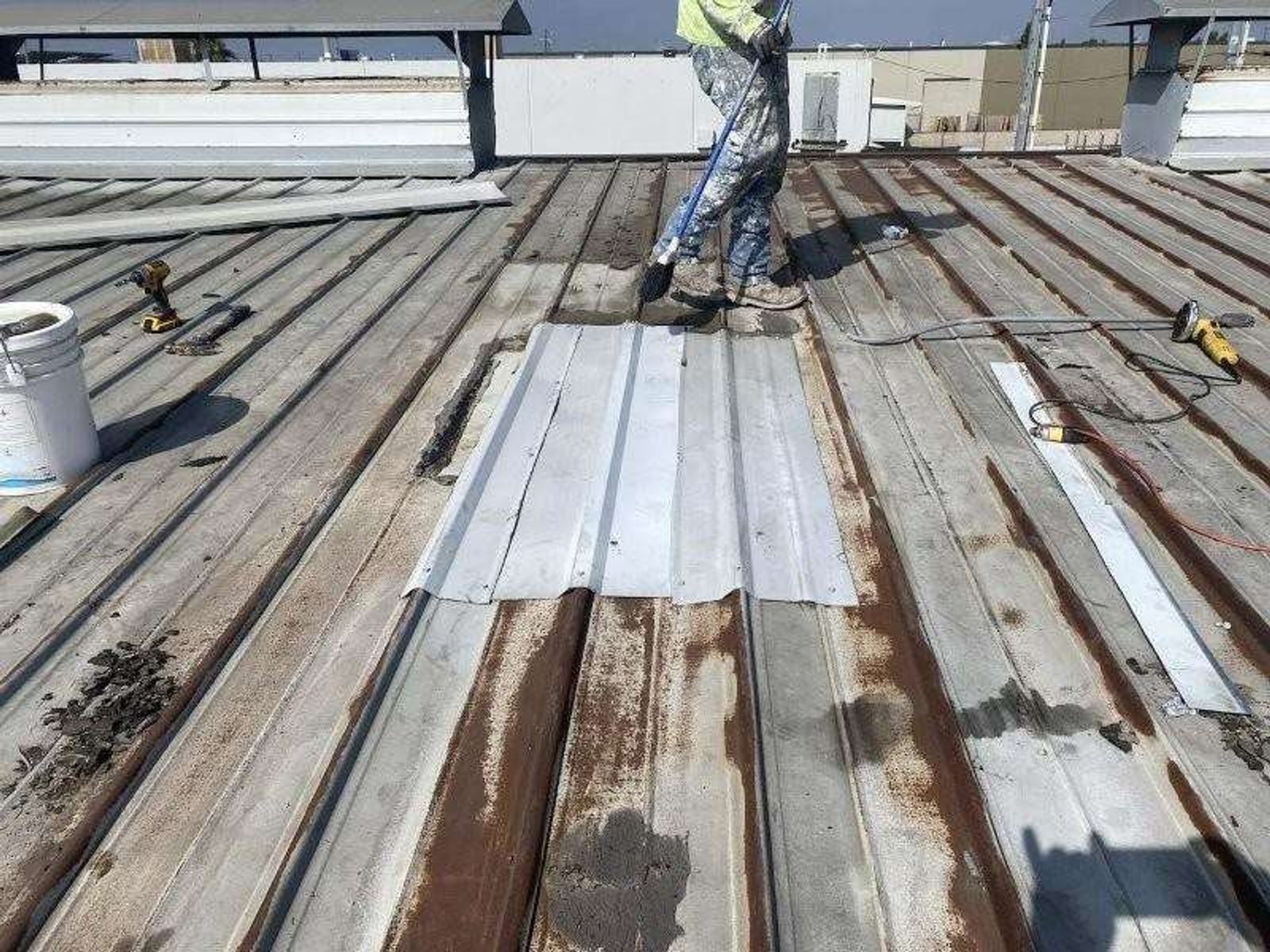
Replacement is the answer when the assembly under the surface has failed. Wet insulation across large areas, a rusting or soft deck, and membrane that splits wherever it is touched all point there. So do leaks that show up in new places after every repair.
Other signs are structural. Ponding that gets deeper each season can mean a sagging deck. Fasteners that have backed out across the field mean the roof has lost its hold on the building.
Age alone is not the trigger. A roof moisture survey with infrared or capacitance scans shows how much of the roof is actually wet. That result often settles whether repair or replacement makes more sense.
Tear-off vs recover
A tear-off removes everything down to the deck. A recover installs a new roof over the existing one. The recover saves disposal and labor, but the code sets firm limits on when it is allowed.
LA County's reroofing code manual spells out those limits. A recover is not allowed over more than one existing layer. It is also not allowed where the existing roof or deck is water soaked or deteriorated.
In any of those cases the roof comes off to the deck. That manual covers unincorporated LA County. The City of Los Angeles and other cities adopt the same state code section with their own amendments.
Before a recover is priced, a few things get confirmed on the roof. Any one of them can rule it out.
- The number of existing roof layers, confirmed with core cuts.
- Moisture in the insulation, mapped across the whole roof.
- Deck condition, from above and from below where it can be seen.
- Curb, flashing, and door threshold heights once new insulation is added.
- Drain and scupper heights relative to the new roof surface.
The new system is a separate decision. Our guide to single-ply membranes and attachment methods covers that choice.
California has no 25 percent repair rule
Owners sometimes hear that repairing more than 25 percent of a roof forces a full replacement. That rule comes from Florida. California has no percentage cap on roof repairs.
What does apply here is the reroofing section of the building code and the energy code. Those are the triggers to plan around.
Repairs still need compatible materials, and a permit when the local office requires one. The size of a repair alone does not force a new roof here. The condition of the roof decides that.
Title 24 reroof requirements
California's 2025 Energy Code applies to permit applications filed on or after January 1, 2026. Any nonresidential roof that is replaced, recovered, or recoated must use products rated by the Cool Roof Rating Council.
A larger trigger applies when the work covers more than 50 percent of the roof or more than 2,000 square feet, whichever is less. A low-slope nonresidential roof then needs an aged solar reflectance of at least 0.63 and a thermal emittance of at least 0.75. An SRI of at least 75 also qualifies.
Replacements and recovers trigger insulation requirements too. A recoat is exempt from the insulation rule, though not from the cool roof rule. Rated products can be checked in the Cool Roof Rating Council directory.
Added insulation raises the roof surface. That is why curb, flashing, and threshold heights get measured early in the project.
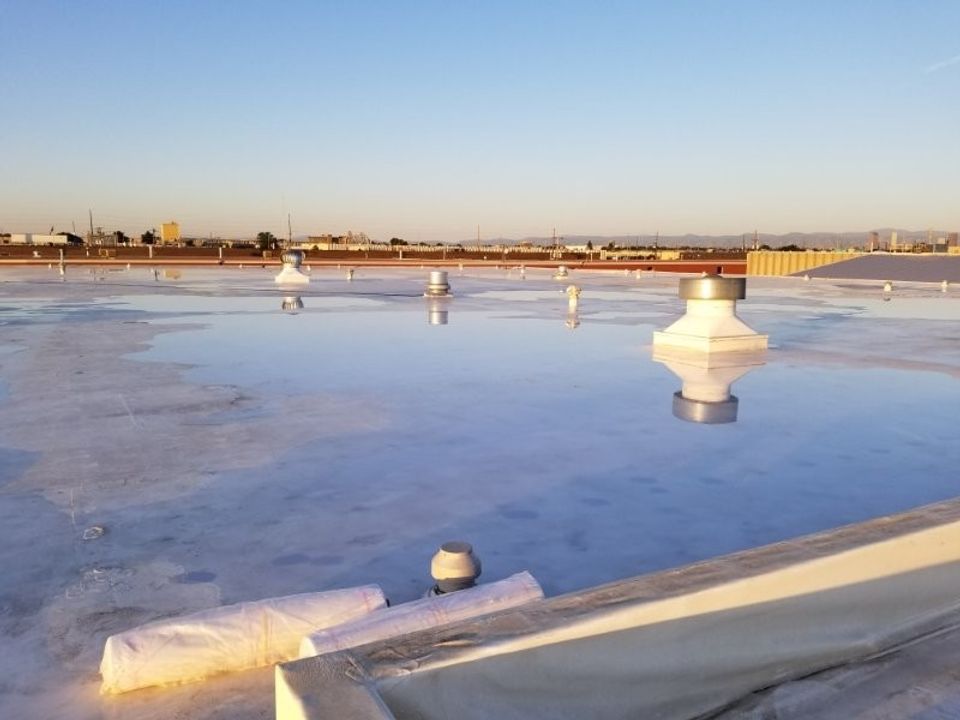
Flat commercial roof with standing water, vents, and rolled materials at the edge.
Reroof permits in Los Angeles
A commercial reroof needs a building permit. The application describes the existing roof, the new system, and how the roof meets the energy code. The city or county inspects the work, and the permit has to be finaled at the end.
Solar arrays add a step. Panels usually come off before the reroof and go back after, which brings in the solar contractor. Rooftop mechanical units may also need a mechanical contractor to disconnect and reset them.
The permit timeline goes into the project schedule from the start. That way the tear-off date is not waiting on paperwork.
Keep the permit card and final inspection record with the building file. Buyers, lenders, and insurers often ask for proof that the last reroof was permitted and closed out.
Replacing a roof on an occupied building
Most commercial roofs get replaced with tenants inside. The working rule is simple. Never open more roof in a day than can be closed and dried in that same day.
Tenants need notice about noise, adhesive odors, and equipment shutdowns. Staging needs room for a dumpster, a lift or crane, and material storage without blocking fire lanes. Night or weekend work is possible when a tenant cannot tolerate daytime noise.
Rooftop equipment often has to be lifted or disconnected while the roof under it is replaced. Tenants who depend on cooling, refrigeration, or server rooms need a plan for that window. Those shutdowns get scheduled with the tenant before the crew arrives.
Drains matter during the job too. Water still has to leave the roof while it is half built, so drain work gets planned around the forecast.
Budgeting and accounting for a replacement
Cost follows roof size, tear-off depth, the amount of wet insulation found, added insulation for code, equipment, and access. A proposal should say how hidden wet insulation or deck damage will be priced. The written proposal carries the number after the roof is walked and cored.
Accounting treats a replacement differently from a repair. The IRS tangible property regulations separate deductible repairs from improvements that get capitalized. Your tax advisor decides where a given project lands.
If you are collecting bids, our installation page covers how to compare roof replacement companies. Read the proposals at the details, where the scopes really differ.
Questions on this service
How many roof layers are allowed on a commercial building in LA County?
Under LA County's reroofing rules, a new roof cannot be installed over more than one existing layer. It also cannot go over a roof or deck that is water soaked or deteriorated. In those cases the old roofing comes off down to the deck.
Do I need a permit to replace a commercial roof in Los Angeles?
Yes. A commercial reroof needs a building permit from the city or county where the building sits. The application covers the existing roof, the new system, and energy code compliance for the roof.
Does a commercial roof replacement have to meet Title 24?
Yes. Under the 2025 Energy Code, nonresidential roofs that are replaced must use rated cool roof products. When the work covers more than 50 percent of the roof or more than 2,000 square feet, whichever is less, low-slope roofs must meet cool roof reflectance and emittance values. Replacements and recovers also trigger insulation requirements.
Is there a 25 percent rule for roof repairs in California?
No. The 25 percent repair rule comes from Florida. In California, the questions are the reroofing section of the building code and the energy code triggers.
Can tenants stay in the building during a roof replacement?
Usually, yes. The roof is opened only as much as can be closed and dried in the same day. Tenants get notice about noise, adhesive odors, and equipment shutdowns, and sensitive work can be scheduled around business hours.
Related commercial roof system installations services
This page is one part of commercial roof system installations. The pages below cover the rest.
Other commercial roof services
Each property usually needs one clear scope, not all five at once. The walk tells us which page below matches the building.
- Commercial Roof Repair
- Commercial Roof Coatings
- Commercial Roof Restoration
- Commercial Roof Inspection and Certification
Ready for a written scope? Request a site visit or call (747) 308-4045.