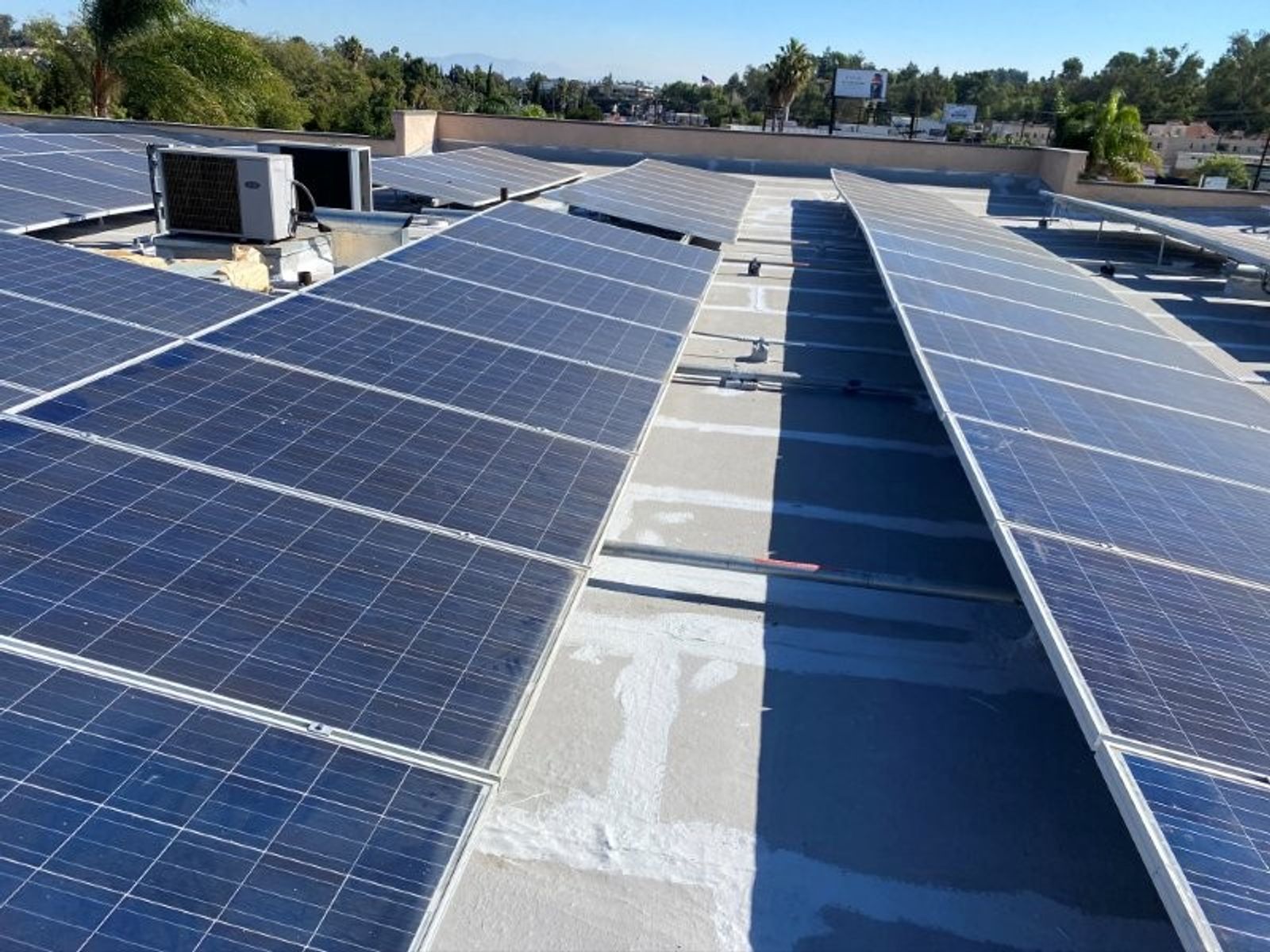
Roof coating around solar panels is a detail job disguised as a field job. The open roof between rows is easy to coat. The racking feet, conduit supports, and shaded strips under the modules are where these projects succeed or fail.
We coat and restore low-slope commercial roofs with solar arrays across greater Los Angeles. This page covers when to coat in place, how the details get sealed, and what changes when the roof under the array needs replacement instead.
Coat in place or remove the array
The first decision is whether the array stays. If the membrane under it is dry, attached, and only losing its surface, coating in place is usually the practical route. If the insulation is wet or the membrane has failed, the panels have to come off.
The array's own plans matter too. An owner planning to replace aging modules soon may time the roof work to that removal. We ask about the array's age and service history before we scope anything.
Coating before an array goes in is the simplest version of this job. If solar is planned, doing the roof first gives the crew open access to every square foot.
Survey the roof under the panels
The roof under an array is the part nobody walks. Debris collects along the rails, water dams behind ballast and wiring, and small splits go unseen for years. A survey covers every row, not just the open aisles.
Racking attachments are the most common leak source on a solar roof. Each foot or stanchion is a penetration with its own flashing, and each one ages. Our guide to tracing a commercial roof leak to its source explains how we find the one that is letting water in.
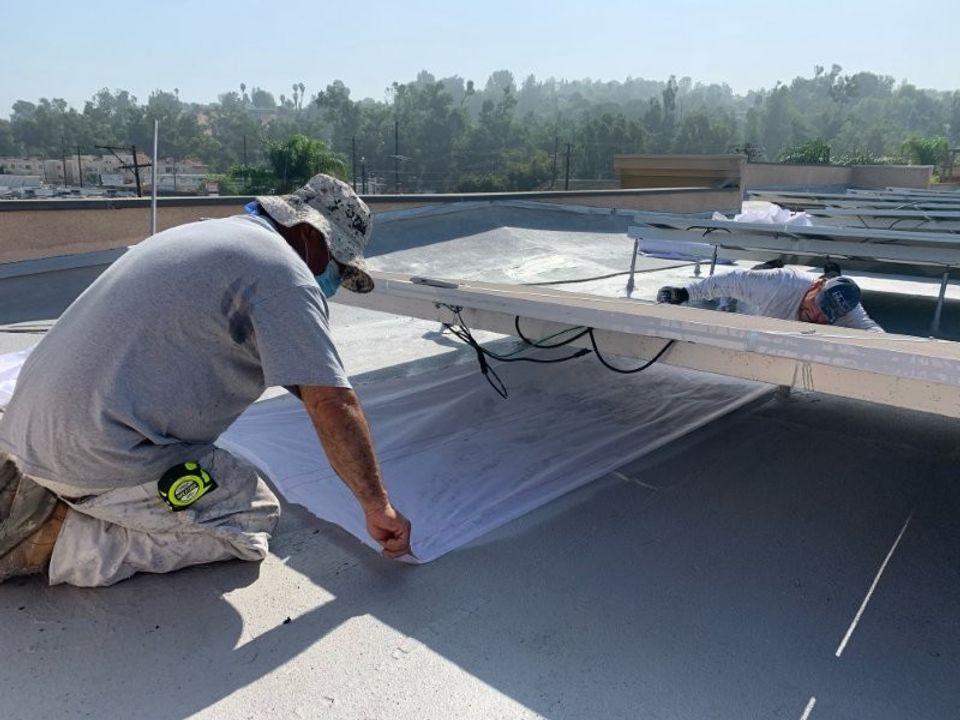
Workers position white sheet material around metal racking supports.
Detailing racking feet and conduit
Sealing at attachments is not optional in the eyes of the building department either. The LADBS solar plan check bulletin requires plans to show roof penetrations sealed with approved methods and products to prevent leaks. A coating project should treat those seals with the same care.
Each detail is cleaned, primed where the system calls for it, and reinforced with fabric set in a base coat. The finish coats then cover the fabric completely. These are the points that get that treatment.
- Racking feet, stanchions, and their existing flashings.
- Conduit supports and any conduit that passes through the roof.
- Combiner boxes and equipment stands set on the membrane.
- Drains and low spots between rows where water collects.
Working under the array
The gap under a module limits what a sprayer can reach. Most of the work under panels is done by brush and roller, and it takes longer per square foot than the open field. Mil gauge readings under the array are the ones most worth recording.
The array has to be protected from the job. Module glass gets covered or masked against overspray, and nobody steps on panels or racking. Electrical work stays with the solar contractor, who confirms what can be touched before we start.
Ballasted racking adds a step. Ballast blocks sit directly on the membrane, so they are shifted in small groups for prep and coating, then set back in their original positions.
Weather windows matter here too. Shaded roof under the panels dries slower than the open field after dew or rain. We check that the surface is dry under the modules, not just between the rows.
Choosing a coating for a solar roof
Drainage and traffic drive the choice. Arrays often slow water on its way to the drains, which favors a ponding-tolerant product along rails and low spots. Panel cleaning and inverter service bring regular foot traffic, which favors a surface that walks well.
Where the roof drains well and service traffic is steady, a water-based system is a fair choice. Our page on acrylic roof coating, primers, and cure windows covers that option in depth.
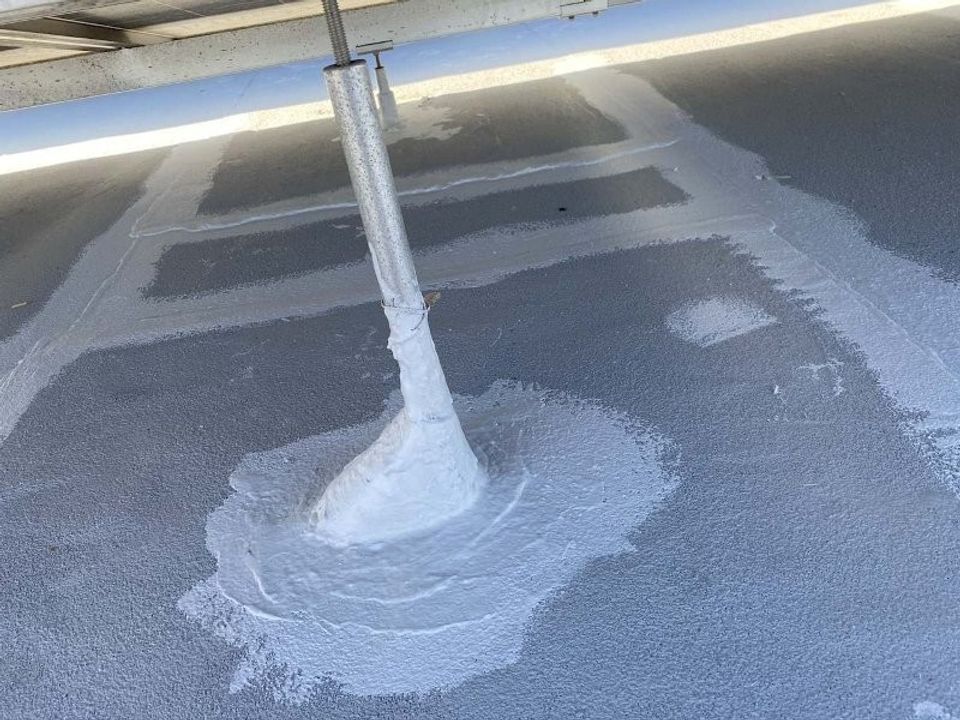
Sealed seams and coated flashings under solar racking.
Reroofing under solar: permits and licenses
When coating is not enough, the array comes off for a new roof. Los Angeles County's Building Code Manual 1512 covers reroofing on roofs with solar in unincorporated areas. It requires a separate permit to reinstall a rooftop array removed for the reroof, in addition to the reroofing permit.
The same manual says reroofing is done by a C-39 roofing contractor and the solar reinstallation by a C-10 or C-46 contractor. It also bars reusing the old bonding clips. When the original solar plans are missing, the system has to be photographed before removal.
A new roof over the old one is limited too. A recover is not allowed over more than one existing layer, or where the roof or deck is water soaked or deteriorated.
Our tear-off versus recover guide explains that call, and the commercial roof replacement process covers sequencing on an occupied building. The City of Los Angeles and Santa Clarita adopt the building code with their own amendments.
Title 24 when a solar roof is recoated
Solar does not exempt the roof around it from the energy code. Under the 2025 Building Energy Efficiency Standards, nonresidential recoats must use a product rated by the Cool Roof Rating Council. That version applies to permit applications filed on or after January 1, 2026.
When more than 50 percent of the roof or more than 2,000 square feet is recoated, whichever is less, a low-slope nonresidential roof needs an aged solar reflectance of at least 0.63 and a thermal emittance of at least 0.75. An SRI of at least 75 also qualifies. A recoat skips the insulation requirement, while a replacement or recover triggers it.
What drives cost on a solar roof
The written proposal carries the number. Array density, the number of attachments, the gap under the modules, and the prep under them move it most. Removal and reinstallation, when needed, are priced and permitted as their own scope.
Coordination with your solar contractor is set before the first day. That covers shutdowns, access routes, and who handles any electrical work. For how the chemistries compare on roofs without arrays, see our commercial roof coating overview.
Questions on this service
Can a commercial roof be coated without removing the solar panels?
Often yes, if the roof under the array is dry and attached. The work goes slower because the panels limit access, and the areas under the modules are prepped and coated by hand. Where the gap is too tight to do the work properly, sections may need to be lifted.
Do solar panels have to come off to replace a commercial roof?
Usually, because a new roof needs clear access to the deck and new flashings at every racking attachment. The array is detached, stored or staged, and reinstalled after the roof is done. That work needs coordination with the solar contractor and its own permit in many jurisdictions.
Who removes and reinstalls solar panels during a reroof?
In unincorporated Los Angeles County, the county building code manual says reroofing is done by a C-39 roofing contractor and the solar reinstallation by a C-10 or C-46 contractor. An A or B licensed contractor may apply for both trades. Other cities may have their own rules.
Do I need a permit to reroof a building that has solar in Los Angeles County?
Reroofing needs a building permit. In unincorporated Los Angeles County, reinstalling a rooftop solar system that was removed for the reroof needs a separate permit as well. The City of Los Angeles and other cities adopt the building code with their own amendments, so check with the local building department.
Should the roof be restored before solar panels are installed?
If the roof surface is aging, yes. Once an array is in place, every repair and recoat under it costs more and takes longer. Coating or repairing first means the roof and the array start their service lives together.
Related commercial roof coatings services
This page is one part of commercial roof coatings. The pages below cover the rest.
Other commercial roof services
Each property usually needs one clear scope, not all five at once. The walk tells us which page below matches the building.
- Commercial Roof Repair
- Commercial Roof Restoration
- Commercial Roof System Installations
- Commercial Roof Inspection and Certification
Ready for a written scope? Request a site visit or call (747) 308-4045.